Eliza
The Reincarnated Demon King's Host Just Wants to Live in Peace, But the Hero Won't Leave Him AloneEliza is the former Hero of Algeya and the warrior who defeated Malthios after he had threatened to conquer the land. Her victory established her as the kingdom’s celebrated defender, but her later actions reveal the cost of making one person embody an inherited institution: the Hero’s duty, its bloodline, and its demand that personal choice yield to perpetual warfare. Her final confrontation with Luc and Theo Bladefoot turns that system against its own champion and ends with her death.
Identity and Heroic Legacy
Eliza’s place in the story begins as history and rumor. Malthios, the Demon King and sworn enemy of the people of Algeya for centuries, claimed that he would have conquered the land if Eliza had not been born. She and her party defeated him, while a persistent rumor held that Malthios cast a spell before dying to transport his soul into another body and continue his reign of darkness. Eliza’s victory therefore has two consequences: it makes her the defining Hero of her generation, and it leaves behind the unresolved threat that eventually becomes central to Theo Bladefoot’s identity.
The Hero’s power is described as physical rather than primarily magical in appearance, granting resilience, speed, strength, accelerated healing, and resistance to magic. These abilities require training from childhood. Eliza began that training at twelve, while Luc began at five, and the contrast places her within a system that turns children into instruments of a public mission. The same power also consumes the Hero’s body rapidly: Heroes on record barely survived into their twenties, and Eliza was already showing signs that the fight with Malthios had shortened her remaining time. Her search for a successor is consequently both practical and ominous, because the institution must continue even when its current bearer is being exhausted by it.
Authority Over Luc and the Heroic Bloodline
Eliza’s authority extends beyond battlefield leadership. She is Luc’s blood relative, and she presents supervision of him as a natural familial obligation, stating that he is her blood and that watching over him is therefore proper. Yet her guardianship is inseparable from control. When Luc was twelve, she caught him slacking in training, dueled him, took the Hero’s sword from him, and ordered the healers not to intervene, insisting that the injury heal on its own as a reminder of his duty. The episode shows how completely Eliza identifies care with discipline: the body of a child is treated as training material, and pain becomes an instructional instrument.
Her expectations also include the continuation of the Hero’s lineage. Luc is told that she may want him to continue their bloodline and sire the next Hero, something that could not be achieved through his relationships with either Theo Bladefoot or the knight who discusses the matter. Eliza’s concern is thus not merely that Luc perform heroic work; she wants him to preserve the institution biologically. Her demand turns family into succession, intimacy into political utility, and the future into a repetition of the past.
Presence and Conflict with Theo Bladefoot
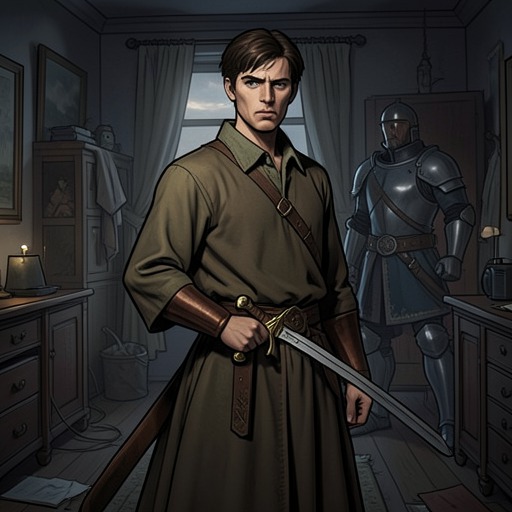
When Theo Bladefoot encounters Eliza, her appearance makes the heroic legend physically immediate. She shares Luc’s dark hair and tanned complexion and wears the same navy, gold-edged coat, but she is taller and has a body shaped by combat. Her face appears deceptively young and round, with a small nose and pouty lips, while her hair is pulled back in an effort to look more severe. The decisive feature is her gaze: amber, emotionless, and without warmth. Theo feels that it pierces through him and may see Malthios beneath the surface of his flesh.
That reaction binds Eliza to the secret at the center of Theo’s existence. She is the person who defeated Malthios, while Theo is the healer whose body contains the Demon King’s soul. Even before the final conflict, the sight of the Hero’s sword triggers Theo’s memory of that blade entering his stomach, linking Eliza’s historical victory to the violence remembered by Malthios inside him. The relationship is therefore not a simple opposition between living Hero and defeated Demon King: Eliza’s presence makes the past active inside Theo, and Theo’s existence threatens to prove that her victory was never final.
Final Confrontation and Death
The conflict becomes public during the trial of the Demon King’s Host. A large mirror spell opens to reveal a crowd in Leafel, with Micah casting at the front and Imani, Dale, Dmitri and his parents, Nib, Amaya, Hayden, and the people of Leafel gathered behind him. The community’s appearance gives Theo and Malthios witnesses and allies beyond the heroic institution. Eliza, by contrast, stands as the concentrated representative of the older order: the former Hero, the keeper of the bloodline, and the person who cannot accept Luc’s refusal.
Luc declares that he has decided it is his duty as the Hero to kill the Demon King. Eliza answers by condemning the choice he has made outside the script she prepared for him. She asks whether he means to end their bloodline and throw away everything for which he has trained his whole life. Luc replies that choosing a quiet and peaceful life with the man he loves is the only choice he has ever made for himself, and that the world should become one in which those born with the Hero’s gift can choose their fate rather than remain bound to duty. Their exchange makes the central conflict explicit: Eliza defends inherited obligation, while Luc rejects the idea that heroic power gives the institution ownership of a person’s future.
Eliza’s emotional mask finally breaks. Her cold gaze turns into an openly hostile expression, and she lunges forward. Luc pushes Theo out of the way, but Eliza is not attacking Theo at first; she draws the Hero’s sword from Luc’s hip and levels it at the pair while Luc shields Theo with his body. The movement collapses the distinction between protecting Algeya and enforcing Eliza’s personal command. The sword that once defeated Malthios is now being used to punish Luc’s refusal and threaten the man he loves.
Theo and Malthios respond together. Malthios experiences panic and the phantom pain of a blade in the stomach, recalling the wound Eliza inflicted when she defeated him. Theo leaps aside and throws the kris with all his strength. Eliza’s sword cuts through the space where Theo had stood, but the kris strikes her in the heart. She gasps, drops the Hero’s sword, and collapses on the grey stone floor as dark blood pools around her. Her death is both a personal killing and the destruction of the most uncompromising embodiment of the old heroic order.
Consequences and Narrative Significance
After Eliza’s death, King Alexis concludes the trial by sentencing Demon King Malthios to life in prison while declaring Theo Bladefoot free of all charges. The judgment separates the host from the soul within him and rejects the assumption that Theo’s possession makes him automatically guilty. Eliza’s death therefore helps produce a legal distinction that her worldview had resisted: a person cannot be reduced entirely to the power, bloodline, or historical identity imposed upon him.
Eliza’s arc also establishes a sharp contrast between two models of heroic succession. She believes the Hero’s gift must reproduce itself through training, blood, and obedience; Luc chooses love, peace, and a shared life with Theo Bladefoot instead. Her insistence on a future shaped like the past leads not to the preservation of the Heroic system but to its crisis. In that sense, Eliza is both the system’s greatest success and one of its final casualties: the warrior who saved Algeya becomes unable to imagine safety except as continued submission to the role that consumed her.